Flavors Beneath the Rooftops: Where Nha Trang’s Architecture Meets Its Street Food Soul
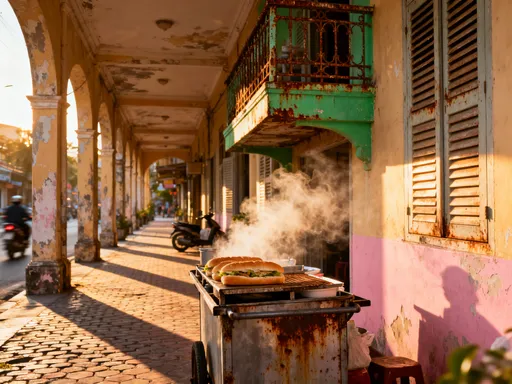
You know that feeling when a city surprises you—not just with its sights, but with the way its flavors live inside its walls? In Nha Trang, Vietnam, I didn’t just taste street food—I saw it. From French-colonial arcades to weathered tile rooftops, every bite came with a sense of place. The way a bánh mì stall fits under a 1920s balcony, or how seafood grills glow beneath old Indochinese shutters—it’s food and architecture dancing together. This is more than a meal. It’s a story written in brick, paint, and fish sauce.
Arrival in Nha Trang: First Impressions of a Coastal Culinary Stage
Stepping into Nha Trang is like entering a living postcard where the sea breeze carries more than salt—it carries the sizzle of grills, the tang of lime, and the rhythmic chop of cleavers on wooden boards. The city unfolds along the crescent-shaped bay, where the long stretch of Tran Phu Street serves as both a seaside promenade and an open-air dining corridor. Here, the urban landscape doesn’t merely host street food—it invites it, shelters it, and in many ways, grows around it. The first thing visitors notice isn’t just the turquoise water, but the constant hum of culinary life: motorbikes parked beside steaming noodle pots, plastic stools spilling onto sidewalks, and clusters of locals gathered around low tables under faded awnings.
What sets Nha Trang apart is how seamlessly food culture is woven into the city’s architectural fabric. Unlike cities where street vendors are temporary or regulated to markets, here they are permanent residents of the streetscape. The layout of the city—narrow alleys branching off the main boulevard, shaded walkways beneath historic buildings, and open spaces near the waterfront—naturally supports a decentralized dining culture. There is no need for formal restaurants when the entire city functions as a kitchen. This organic integration is not accidental; it is the result of decades of urban evolution where form follows function, and flavor follows form.
The Old Quarter, nestled just behind the beachfront, reveals another layer of this relationship. Colonial-era buildings with peeling paint and iron railings stand shoulder to shoulder with modern cafes and family-run eateries. These structures, many over a century old, were not designed for street food, yet today they cradle some of the city’s most beloved stalls. A bowl of bún cá, served beneath a vaulted arcade, tastes different not just because of the recipe, but because of the echo of footsteps above, the dappled sunlight filtering through louvered shutters, and the sense of continuity between past and present. The architecture does not overshadow the food—it enhances it.
Urban planning in Nha Trang has, until recently, allowed this symbiosis to flourish. Sidewalk kitchens operate with informal permissions, often passed down through generations. Alleyway stalls emerge at dawn and vanish by midnight, their presence as regular as tides. Seaside grills, built on sand or concrete platforms, serve fish pulled from the water hours earlier. The proximity of production and consumption—fishing boats unloading steps from open-air kitchens—creates a freshness that cannot be replicated elsewhere. This is a city where geography, history, and gastronomy converge, and where every meal is an act of place.
French Colonial Echoes: How 20th-Century Design Shapes Street Food Scenes
The architectural heartbeat of central Nha Trang beats strongest in its French colonial legacy. Built during the early 1900s as a seaside retreat for French administrators and wealthy Vietnamese families, the city’s downtown still bears the marks of Indochina-era urban planning. Wide boulevards, symmetrical facades, and elevated ground floors with continuous arcades define the streetscape. These arcades—known locally as “passages”—were originally designed to shield pedestrians from tropical sun and monsoon rains. Today, they serve a new but equally vital purpose: sheltering a thriving ecosystem of street food vendors.
Walking beneath these arched walkways, one finds a continuous ribbon of culinary activity. A coffee stall occupies the corner of a 1920s building, its plastic tables tucked neatly under the curve of a stone arch. Nearby, a woman stirs a pot of simmering phở beneath a high ceiling that once echoed with colonial bureaucracy. The architecture provides more than shade; it offers structure, acoustics, and a sense of permanence. The thick masonry walls regulate temperature, keeping interiors cooler during the day, while the elevated floors allow for airflow that carries away steam and smoke. These are not incidental benefits—they are design features that have been repurposed with quiet brilliance.
Many of the original buildings have been adapted rather than replaced. Ground-floor spaces, once used as offices or residences, now house family-run eateries specializing in regional dishes. A former colonial townhouse might now host a bánh mì shop, its wooden doors wide open to the street, the scent of roasted pork and pickled vegetables mingling with the salty air. The transition from private to public use has been gradual, almost invisible, reflecting a cultural respect for continuity. There is no stark contrast between old and new—instead, there is layering, a palimpsest of uses that honors the past while serving the present.
Preservation in Nha Trang is not driven by strict heritage laws, but by practicality and affection. Building owners recognize the value of these structures not as relics, but as functional assets. The arched walkways, for instance, create natural storefronts that require minimal modification. A vendor needs only a table, a stove, and a sign to become part of the streetscape. This low barrier to entry supports economic resilience, allowing small-scale entrepreneurs—often women—to operate with minimal overhead. The architecture, in this way, becomes an enabler of livelihood, not just aesthetics.
Indochine Fusion: Blending Vietnamese Craft with European Forms
Beyond pure colonial design, Nha Trang’s most distinctive buildings reflect a hybrid style known as Indochine architecture—a fusion of French urban planning and Vietnamese craftsmanship. This style emerged in the early 20th century as local builders adapted European forms to tropical conditions and cultural preferences. The result is a unique aesthetic that balances symmetry with ornamentation, formality with warmth. In the heart of the city, one sees pastel-colored facades with green or blue shutters, tiled floors in geometric patterns, and wooden balconies carved with lotus motifs and scrolling vines.
These decorative elements do more than please the eye—they shape the experience of eating. A bowl of mì quảng served beneath a green-painted balcony with rusting iron rails feels more authentic, not because the dish has changed, but because the environment deepens the sense of immersion. The play of light through wooden lattices, the texture of hand-laid tiles underfoot, the faint creak of aged wood—all contribute to a multisensory meal. In such spaces, food is not consumed in isolation; it is part of a broader sensory narrative.
Small eateries in these buildings often use architecture to distinguish themselves. A bright red door, a vintage ceramic sign, or an open-air kitchen framed by ornate columns can become a landmark. These details are not mere decoration; they signal identity and quality. Locals know which stalls have been around for decades, often because the building itself tells the story. A cracked tile or a mismatched shutter speaks of longevity, of a place that has weathered time and still serves fresh food every day.
The atmosphere created by Indochine architecture is one of quiet elegance. Unlike modern glass-fronted restaurants, these spaces feel lived-in, intimate, and grounded. They invite lingering, not rushing. A customer might sit for an hour over a single cup of cà phê sữa đá, watching the street life unfold beneath a shaded balcony. This slowness—this permission to be present—is a subtle but powerful aspect of the dining experience. It is no coincidence that some of the city’s most cherished food memories are formed in these in-between spaces: not quite indoors, not quite outdoors, but fully embedded in the rhythm of the city.
Modern Markets: Where Concrete, Glass, and Tradition Collide
As Nha Trang has grown into a major tourist destination, new food spaces have emerged that reflect contemporary urban needs. The renovated Nha Trang Market, once a bustling but disorganized collection of stalls, has been transformed into a multi-level complex with improved sanitation, lighting, and ventilation. Nearby, seaside food courts with sleek counters and shaded seating areas cater to visitors seeking comfort alongside authenticity. These modern spaces represent an effort to balance hygiene and efficiency with cultural preservation.
The use of concrete, glass, and steel in these environments brings undeniable functional benefits. Stainless steel countertops are easier to clean, glass enclosures protect food from dust and insects, and overhead fans improve air circulation. For health and safety, these upgrades are significant. Yet, some regulars argue that something intangible has been lost—the spontaneity, the rawness, the sense of stumbling upon a hidden gem. In the old market, vendors were packed tightly together, their stalls separated only by cloth dividers. The air was thick with the scent of fermented fish, roasted peanuts, and steamed rice cakes. It was chaotic, yes, but also alive in a way that feels harder to replicate in a regulated space.
The challenge lies in preserving authenticity without compromising safety. Some vendors in the new market have adapted beautifully, maintaining their recipes and service style while benefiting from better infrastructure. Others struggle with the higher rents and formal requirements, leading to a gradual shift in who can afford to operate. The result is a subtle homogenization—fewer family-run stalls, more chain-like operations. This raises important questions: Can tradition thrive in a sanitized environment? Can a city modernize without erasing the very qualities that made it special?
Lighting and layout play a crucial role in shaping customer experience. In the old alleyways, food was often illuminated by single bulbs or the glow of charcoal grills, creating a warm, intimate ambiance. In modern food courts, fluorescent lights and uniform spacing can feel clinical. Yet, thoughtful design can bridge this gap. Some newer spaces incorporate wooden accents, open kitchens, and outdoor seating that mimic the feel of traditional stalls. The goal should not be to replicate the past, but to carry its spirit forward—ensuring that progress does not come at the cost of soul.
Hidden Eateries in Historic Corners: Off-the-Beaten-Path Food Gems
While the beachfront and main streets draw the crowds, some of Nha Trang’s most memorable meals are found in its quieter, older neighborhoods. Tucked into narrow lanes where motorbikes barely fit, these hidden eateries operate in buildings that have changed little since the 1930s. Here, tiled roofs curve gently over courtyard entrances, wooden beams bear the marks of decades, and shuttered windows open to reveal kitchens no larger than a closet. These spaces are not designed for tourists—they are part of daily life.
One such find is a family-run bún chả stall beneath a faded villa on Nguyen Thien Thuat Street. The building, once a private residence, now hosts a single dining room with four tables and an open grill in the corner. The owner, a woman in her sixties, prepares the dish exactly as her mother taught her—grilled pork patties served with rice noodles, fresh herbs, and a tangy dipping sauce. The walls are lined with framed photos of past customers, and the ceiling bears water stains from years of monsoon leaks. None of this detracts from the experience; if anything, it enhances it. The imperfections speak of authenticity, of a place that has not been polished for outsiders.
Another gem is a coconut coffee nook inside a crumbling townhouse near the old post office. Accessed through a narrow passage, the space opens into a small courtyard where customers sit on low wooden stools. The coffee is served in coconut shells, the milk drawn fresh from the fruit. The building’s original tile floor, though cracked in places, still displays its intricate floral pattern. A single ceiling fan turns slowly overhead, cutting through the afternoon heat. There are no menus, no signs, no online presence—just word of mouth and the instinct to explore.
These off-the-beaten-path locations matter because they represent continuity. They are not re-creations or themed experiences; they are real, functioning parts of the city’s social fabric. The architecture here has not been preserved for tourism—it has simply been allowed to endure. In doing so, it protects a way of life. When a young couple inherits their grandparents’ home and turns the ground floor into a noodle shop, they are not making a statement about heritage—they are simply living it. These spaces remind us that culture is not only found in museums or official landmarks, but in the everyday choices of ordinary people.
Seaside Architecture and Seafood Culture: Grills, Shacks, and Ocean Views
Along the shoreline, where the land meets the South China Sea, a different kind of food architecture emerges—one built for immediacy and simplicity. Here, temporary or semi-permanent structures dominate: bamboo huts, corrugated metal roofs, and open-air kitchens raised on wooden stilts. These shacks are not designed to last; they are built to serve, to breathe, and to adapt. Their materials are chosen for function—lightweight, affordable, and easy to repair after storms or high tides.
The design of these seaside kitchens follows the logic of the catch. Fish, squid, and shrimp are often grilled within minutes of being pulled from the water. The open layout allows cooks to work quickly, with wide service windows facing the beach. Elevated floors promote airflow, keeping the space cooler and reducing moisture buildup. Large overhangs provide shade without blocking the breeze. Every element serves a purpose, and nothing is superfluous. This is architecture stripped down to its essentials, shaped by climate, economy, and culinary need.
The experience of eating here is defined by proximity. Diners sit on plastic stools just meters from the water, watching boats bob in the distance while their meal sizzles on a charcoal grill. The sound of waves blends with the crackle of fat hitting hot coals. The menu is simple—grilled fish, steamed clams, salted squid—but the flavors are intense, amplified by the setting. There is a direct line from ocean to plate, and the architecture reinforces that connection. Unlike formal restaurants, where the kitchen is hidden, here the cooking is on full display, part of the performance of the meal.
These structures are vulnerable—exposed to erosion, storms, and rising sea levels. Yet their impermanence is part of their strength. When a shack is damaged, it is rebuilt quickly, often in the same spot, by the same family. This resilience reflects a deeper cultural attitude: that food and place are inseparable, and that the effort to maintain both is worth it. The seaside grill is not just a place to eat—it is a declaration of belonging, a small act of defiance against displacement and standardization.
Why This Blend Matters: Preserving Identity Through Food and Form
The fusion of food and architecture in Nha Trang is more than a charming coincidence—it is a form of cultural resilience. In a world where global chains and generic developments threaten local character, the city’s streetscapes offer a powerful alternative. Here, heritage is not frozen in time; it is lived, used, and adapted. A 1920s balcony shelters a modern noodle stall. A colonial arcade hosts a third-generation coffee vendor. A seaside shack serves fish caught that morning. These are not isolated examples; they are threads in a larger tapestry of identity.
Yet this balance is fragile. Rapid development, driven by tourism and real estate investment, poses a real threat. Historic buildings are being demolished to make way for high-rises and hotels. Traditional markets are being relocated or rebranded into commercial complexes. The pressure to modernize is understandable, but it must be tempered with care. Once a building is gone, the memory it carried—the recipes tested in its kitchen, the generations that gathered beneath its roof—becomes harder to trace.
Mindful urban planning can protect both culinary heritage and architectural history. Policies that incentivize adaptive reuse, support small vendors, and preserve historic districts can ensure that progress does not erase the past. Cities like Hoi An and Luang Prabang have shown that tourism and tradition can coexist when guided by thoughtful design. Nha Trang has the opportunity to follow a similar path—not by freezing the city in time, but by allowing it to evolve with intention.
The true value of this blend lies in its ability to root people in place. When a visitor eats a meal beneath a colonial arcade or in a hidden courtyard, they are not just consuming food—they are participating in a story. They taste the salt of the sea, the smoke of the grill, and the quiet endurance of a culture that values continuity. In that moment, the city reveals itself not as a destination, but as a living entity, shaped by history, sustained by community, and expressed through every bite.
Nha Trang’s true flavor isn’t just in its spices or sauces—it’s in the spaces where food lives. From colonial balconies to beachside shacks, architecture shapes how we experience cuisine. By preserving these environments, we protect not just buildings, but the soul of a city’s daily life. The next time you eat on the street, look up. You might just taste the history above you.